
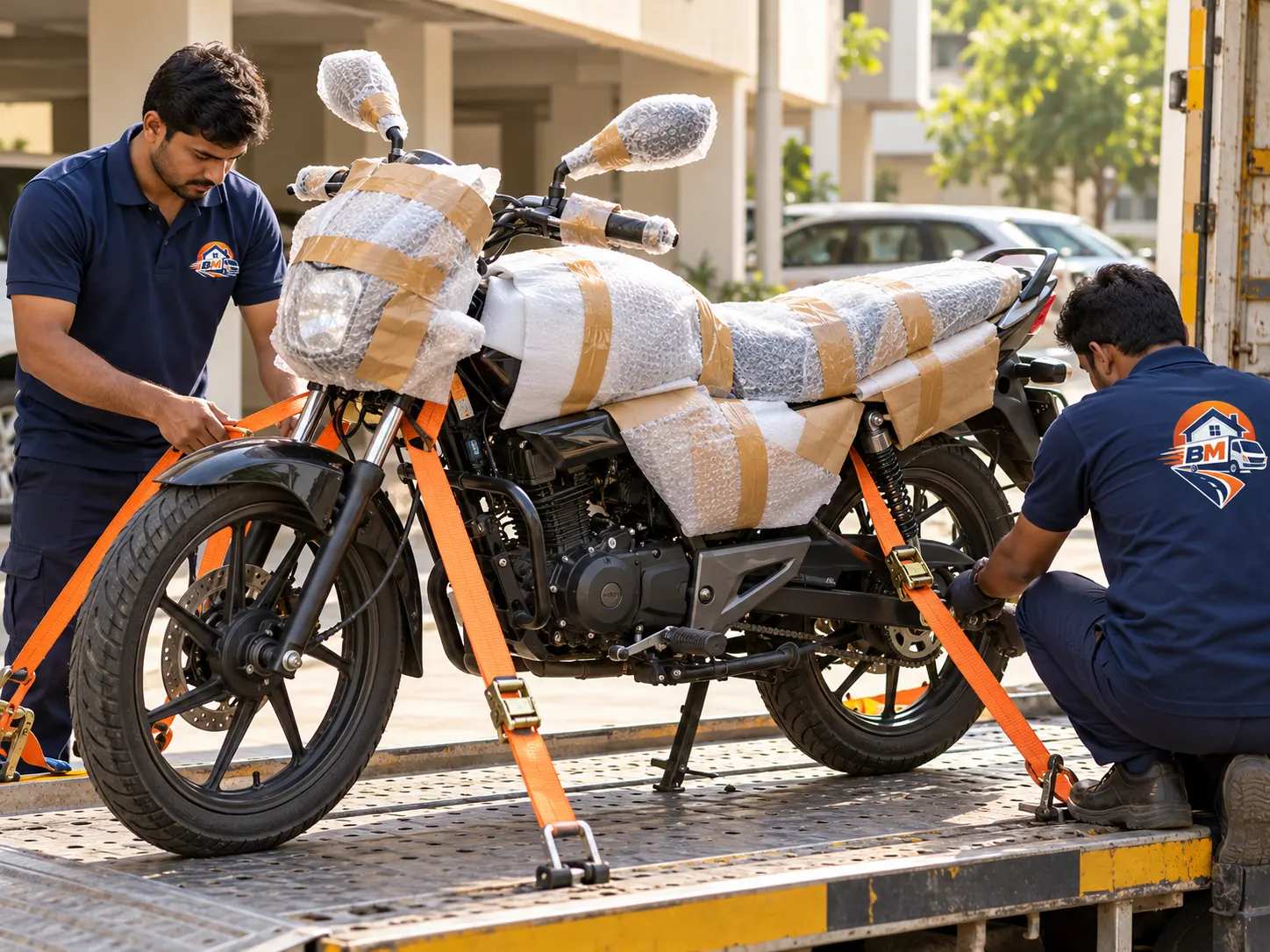
Scooters and motorcycles need proper wrapping on the tank, mirrors and handles, and secure tying in the vehicle so nothing shifts on the road.
Your two-wheeler can move on its own or with your household goods. Either way it should be listed on the quote with a condition note.
What's usually included
- Wrapping and padding of the bike
- Secure loading and tying in the vehicle
- Condition note at pickup
- Delivery at the destination
The exact scope is on the mover's written quote.
How to prepare
- Keep RC and insurance copies ready
- Drain fuel to a minimum if the mover asks
- Remove helmets, bags and accessories
- Photograph the bike before packing
 Illustration
Where bike transport is available
Two-wheeler transport is available to and from Tier 1 and Tier 2 cities. Tell us both cities when you ask for a quote, and our team will confirm whether a verified mover can take your bike on that route.
How bikes are packed
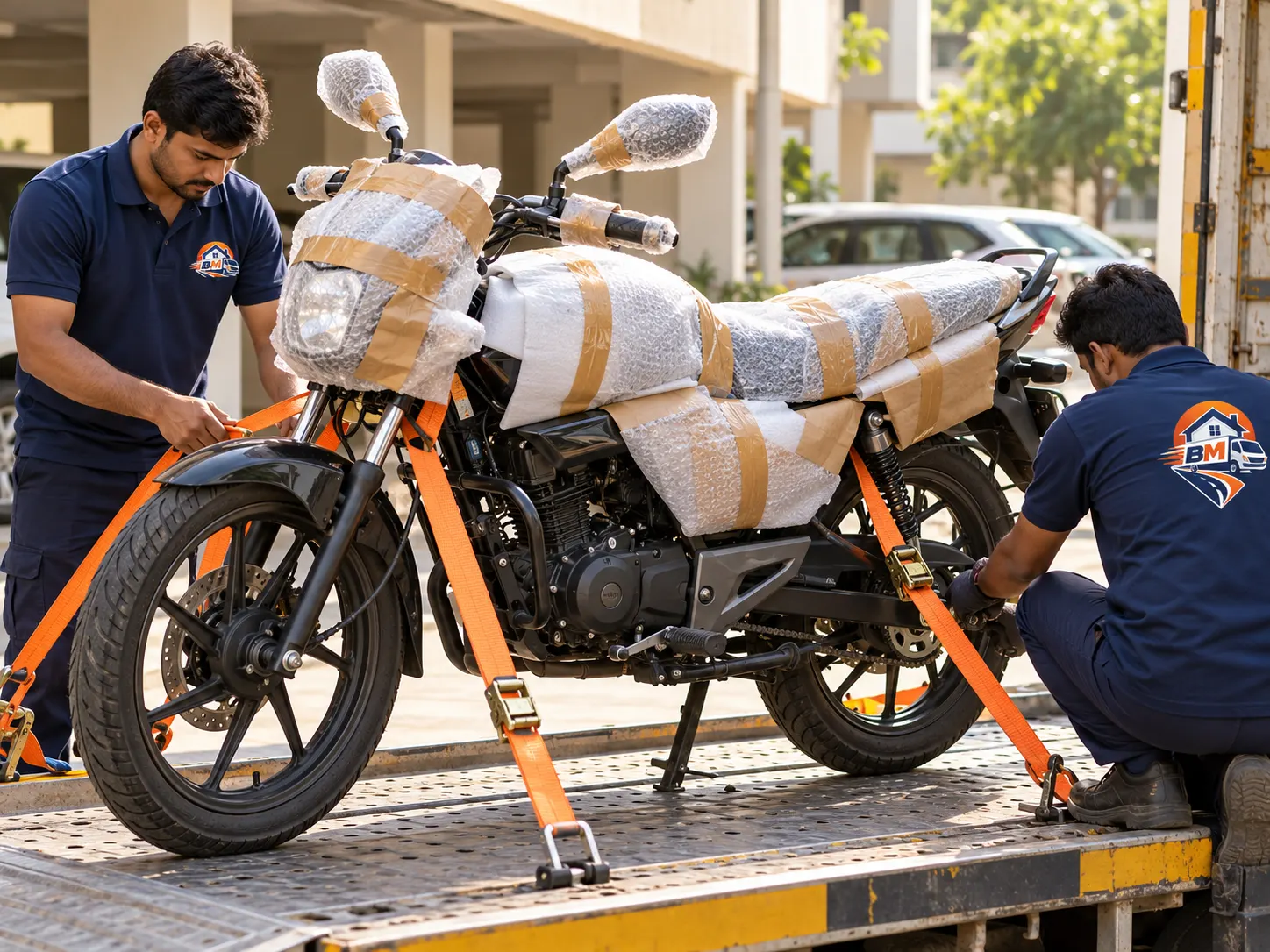
Two-wheelers are usually wrapped in layers: foam or bubble wrap on the tank, mirrors and other parts that scratch easily, and stretch wrap or corrugated sheets over the whole bike. Mirrors may be removed and packed separately. Some movers use a wooden frame or crate for valuable bikes on long routes.
Ask how the mover packs and secures bikes on the vehicle, and whether the bike travels with household goods or on a separate vehicle.
Preparing the bike
Movers usually ask for most of the fuel to be drained, leaving just enough to ride it on and off. Remove accessories such as saddle bags, phone mounts and top boxes, or list them on the condition report. Check the tyres and battery.
Wash the bike a day or two before, and photograph it from every side in good light. Note any existing scratches and dents on the condition report at pickup.
Electric scooters
Electric scooters can usually be moved like any other two-wheeler, but tell the mover when you ask for a quote. They may have rules about the battery's charge level. If the battery is removable, ask whether it should travel with the scooter or with you.
Keep the charger and any keys or cards with you, and check that you can charge at the new home before the scooter arrives.
Documents and insurance
Keep copies of the registration certificate and insurance with the bike file, and the originals with you. The mover will tell you what they need, usually these copies and your ID.
Ask what the risk coverage includes and how a claim works. If you're moving to another state, ask the transport department there about re-registration rules.
Superbikes and vintage bikes
High-value, vintage or modified bikes need more care than everyday commuters. Ask whether the mover can crate the bike, how it will be secured on the vehicle and whether it can travel on a dedicated vehicle rather than with other goods.
Photograph the bike in detail before handover, including any modifications, and list accessories separately on the condition report. Check the insurance terms carefully, since standard transit cover may have limits for high-value vehicles.
Short moves within a city
For a move within the same city, most people simply ride the bike to the new home. If that's not practical, for example because the bike isn't roadworthy or nobody can ride it, ask for it to be moved with the household goods and listed on the quote.
Within a city, the bike may be loaded last and unloaded first. Check it at the new home before the crew leaves.
Rail parcel or a mover?
Some people send bikes by rail parcel. It can work, but you usually handle the packing, paperwork, drop-off and collection yourself. A mover collects from your door, packs the bike and delivers it, which is simpler if you're also moving household goods.
Compare what each option includes, how the bike is packed, who is responsible for it on the way and what insurance applies.
Packing the bike's extras
Helmets, riding jackets, covers, locks and spare parts are easy to lose in a move. Pack them together in one labelled carton, or carry the helmet and keys yourself, rather than leaving them loose with the bike.
If the bike has a removable seat bag, top box or phone mount, take it off and pack it separately. Note the bike's odometer reading at pickup on the condition report, and check it again at delivery.
At delivery
Unwrap the bike in front of the crew if you can, and check it against your photos and the condition report. Look at the tank, mirrors, lights, handlebars and body panels, and start the engine. Note any new marks on the delivery note with photos before signing.
Refuel or charge the bike before riding it far, since it will arrive with very little fuel or charge.
Every mover is checked before they work with us
- Office visited in person
- Godown or storage facility visited, where applicable
- GST details checked
- Customer references called
- General operating setup reviewed
Questions about bike transport
Does the bike have to travel with my household goods?
No. It can move on its own or together with your home move. Moving them together is usually simpler to coordinate.
What documents are needed for a bike?
Photocopies of the RC and your Aadhaar. Keep the originals with you.
Should I remove the mirrors?
Often yes. Ask the mover; many remove and pack mirrors separately.
Can I send two bikes together?
Usually, if both are listed on the quote with their own condition notes.
Can a bike that doesn't run be moved?
Usually yes. Tell the mover so they bring enough people to load it, and list it on the quote.
How much fuel should be left in the bike?
Very little. Most movers ask for the tank to be nearly empty.
Should I record the odometer reading?
Yes. Note it on the condition report at pickup and check it at delivery.
Can my helmet travel with the bike?
It's safer to carry it yourself, or pack it in a labelled carton with the bike's other accessories.
Do I need to be there when the bike is collected?
You or someone you trust should be, to check and sign the condition report with the mover.
Will the bike be crated?
Most bikes are wrapped rather than crated. Ask about a crate for valuable or vintage bikes on long routes.