
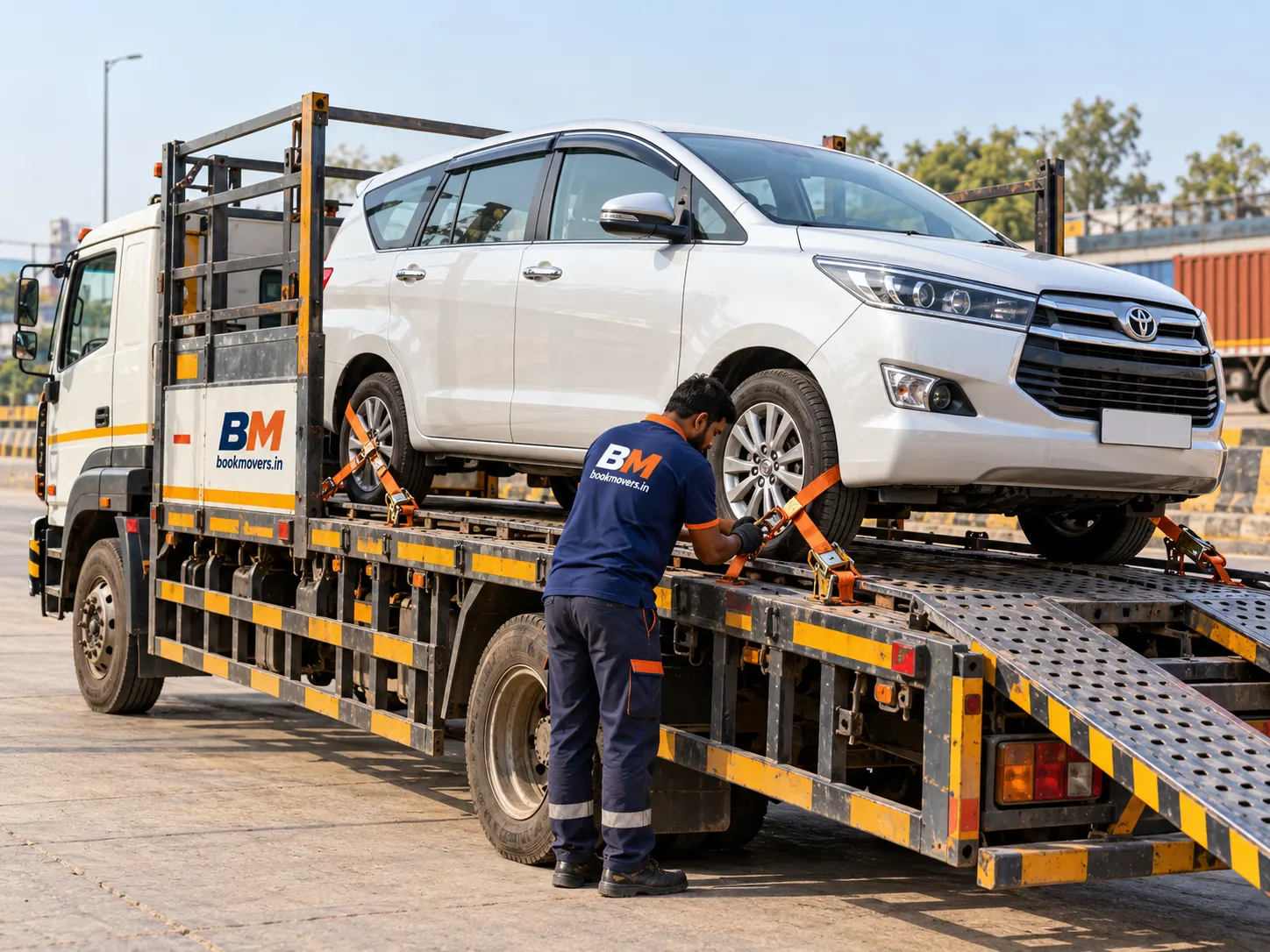
 Illustration
Handing your car to a transporter is a leap of faith. It will spend days on a carrier, be loaded and unloaded by people you have just met, and arrive in a city where you may not even be yet. Insurance is meant to make that safe, but "fully insured" means very little until you know what the cover actually is.
This guide explains how transit cover for a car usually works, what it commonly leaves out, where your own motor insurance comes in, and what you can do at pickup and delivery so that a claim, if you ever need one, is straightforward. Every policy is different, so treat this as a list of questions to ask, not as a description of any particular policy.
On quotes from movers we work with, this transit cover is called risk coverage. It is optional, you choose whether to take it, and it is charged at 3% of the value you declare. Its exact terms are written on your quote.
Two kinds of cover to think about
Transit cover arranged through the mover. Many car transporters offer cover for the journey, usually priced on the value you declare for the car. Its terms — what is covered, what is excluded, how claims are made — should be written on or attached to your quote.
Your own motor insurance policy. Your existing car insurance may or may not cover the car while it is being carried on another vehicle. The only way to know is to ask your insurer and read your policy. Do this before the move, not after something has gone wrong.
The two can overlap or leave gaps. Knowing both before handover is the single most useful thing you can do.
| Situation | Is it usually covered? | What to check |
|---|---|---|
| Damage while loading or unloading | Often, if the cover includes handling | Whether loading and unloading are named in the terms |
| Damage during the journey | Usually, within the declared value | The declared value and any excess you pay |
| Total loss, e.g. an accident | Usually | How the payout is worked out |
| Scratches that were there before pickup | No | That they are marked on the condition report |
| Mechanical or electrical faults | Usually not | Whether the car was checked at pickup |
| Belongings left inside the car | Usually not | Whether the transporter allows items inside at all |
| Delay in delivery | Usually not | The expected delivery date on the quote |
What transit cover commonly leaves out
- Damage that existed before pickup — which is why the condition report matters so much
- Mechanical, electrical or battery problems that are not caused by an accident in transit
- Personal belongings or accessories left inside the car
- Delays, and the cost of a hire car while you wait
- Damage reported after the claim window in the terms has closed
None of these is universal. Some cover is wider and some narrower. The point is to find out which applies to yours before the car leaves your hands.
The declared value
Transit cover is usually worked out on the value you declare for the car. Declare too little and any payout may be limited to that figure; the cost of the cover usually rises with the value. Ask the transporter how the value should be set for your car and keep a note of what you declared.
Before pickup: prepare the car
- Wash the car so scratches and dents are visible in photos
- Photograph every side, the roof, the wheels and the dashboard, with the date
- Note the odometer reading and fuel level
- Remove valuables, loose accessories and anything not fixed to the car
- Keep copies of the RC and insurance in the car file, and your originals with you
- Leave roughly a quarter tank of fuel unless the transporter asks otherwise
- Tell the transporter about any quirks: a weak battery, an alarm, a sticky lock
At pickup: the condition report
The condition report is the most important document in a car move. It records every existing mark on the car before it is loaded. Walk around the car with the transporter's representative, check that every scratch and dent you know of is on the report, and only then sign it. Keep a copy, and photograph the signed report if you can.
If the representative is in a hurry, don't let that rush you. A missing mark on the pickup report can turn a fair claim into an argument later.
At delivery: check before you sign
Inspect the car in daylight if you can, against your photos and the pickup report. Check the body, wheels, lights, mirrors and windscreen, and start the car. If you find anything new, write it on the delivery note, photograph it with the transporter present, and tell the transporter in writing the same day. Don't sign a note saying the car arrived in good condition until you have checked.
Car transport insurance checklist
Open or enclosed carrier?
Most cars travel on open carriers that hold several vehicles. Some transporters also offer enclosed carriers, which protect the car from dust, rain and stones, usually at a higher price. If your car is new, high-value or being moved in the monsoon, ask whether an enclosed option exists on your route and how the cover differs.
Questions to ask the transporter
- Is transit cover included, optional, or not offered?
- What does it cover, and what are the exclusions?
- How is the car's value declared, and what does the cover cost?
- Is there an excess I pay on a claim?
- How and by when must damage be reported?
- Will the car be moved between carriers during the journey?
Collecting the car at the destination
Agree in advance where and when the car will be delivered, and who will receive it if you're not there yet. Whoever collects it should have the pickup photos and condition report, check the car before signing, and note any damage on the delivery note with photos. If you can't be there, choose someone careful and brief them on what to look for.
If something is damaged
Record it at delivery, on the delivery note and in photos. Then write to the transporter promptly with the photos, the pickup and delivery reports and your quote, and ask how the claim will proceed under the cover's terms. Keep every message. Tell our team too: we'll help you follow it up with the mover.
How bookmovers.in fits in
Before a mover joins bookmovers.in, our team visits their office and godown, checks their GST details, and calls customer references. When you move a car through us, your requirement goes to one verified mover, and you book on their written quote. Read the transit cover terms on that quote with this guide, and ask us if anything is unclear.