
 Illustration
A two-wheeler is often the most-used vehicle in an Indian household, and the one people worry about most during a move. It's light enough to be damaged easily, valuable enough to matter, and small enough that it's tempting to treat it as an afterthought. A little planning makes sure it arrives the way it left.
This guide covers the main ways to move a bike between cities, how it should be packed, what you need to do before handover, which documents to keep, and how to check it when it arrives.
Your options
There are three common ways to get a bike to a new city. You can ride it yourself, which works for shorter routes if you're comfortable with the distance and the weather. You can send it with a packers and movers company, either with your household goods or on its own. Or you can arrange a rail parcel yourself, which means handling the packing, paperwork, drop-off and collection on your own.
| Option | Suits | Things to weigh |
|---|---|---|
| Ride it yourself | Short routes, good weather, an experienced rider | Fatigue, weather, fuel and tolls, and the time away |
| With your household move | Families moving the whole home | Listed on the same quote, usually on the same vehicle |
| Separately with a mover | When only the bike is moving | Door-to-door pickup and delivery; ask how it's packed |
| Rail parcel | People happy to handle the process themselves | You pack, book, drop off and collect; check the current rules with the railways |
How a bike should be packed
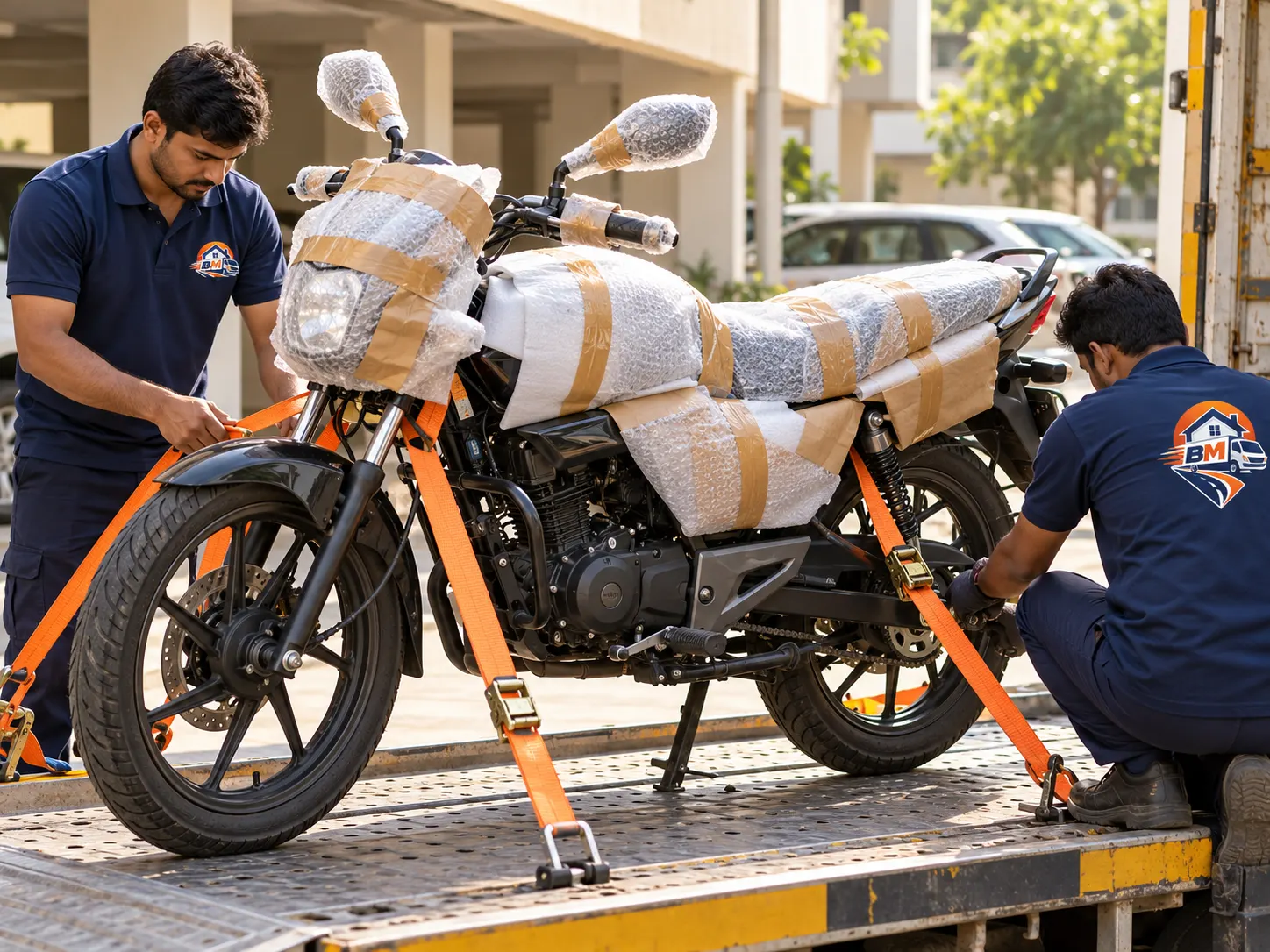
Good packing protects the parts that scratch, bend or break most easily: the fuel tank, mirrors, indicators, headlight and body panels. Movers usually wrap these in foam or bubble wrap first, then cover the whole bike in stretch wrap or corrugated sheets. Mirrors are often removed and packed separately. For valuable or vintage bikes, a wooden frame or crate gives more protection on long routes.
On the vehicle, the bike should stand upright, secured with straps so it can't tip or slide, and kept clear of heavy cartons that could fall on it. Ask the mover how they do this, especially if the bike is travelling with household goods.
Preparing the bike
Before handover
If you have an electric scooter, tell the mover when you ask for a quote. They may have rules about the battery's charge level, and if the battery is removable, you'll need to decide whether it travels with the scooter or with you. Keep the charger with you either way.
Documents
Keep copies of the registration certificate and insurance in the bike's file, and carry the originals yourself. The mover will tell you exactly what they need, usually copies of these and your ID. They carry the transport documents for the vehicle.
If you're moving to another state, ask the transport department in your new state about any rules for re-registering the vehicle. That's separate from moving the bike, and the rules can change, so check the current process with them rather than relying on what someone else did.
Insurance
Ask the mover what the risk coverage includes, what it costs and how a claim is made, and get the terms on the written quote. Check with your own insurer whether your policy covers the bike while it's being transported; many don't. For a high-value bike, check whether the transit cover has a limit that's lower than the bike's value.
Timing
If the bike travels with your household goods, it usually arrives with them. If it travels separately, it may have its own delivery date. Ask for the expected date in writing, and plan how you'll get around until it arrives, especially if you rely on it for work.
Weather matters on long routes. In the monsoon, ask how the bike is protected from rain on the vehicle, and check it for water in the electrics before you ride it far.
At delivery
Unwrap the bike in front of the crew if you can. Compare it with your photos and the condition report: the tank, mirrors, lights, indicators, handlebars, body panels and wheels. Check the odometer reading. Start the engine, check the brakes, and look for leaks. Note any new marks on the delivery note with photos before signing, and tell the mover the same day.
The bike will arrive with very little fuel, so plan to refuel nearby before riding far. If anything feels wrong, such as a bent lever or a stiff throttle, have it checked before you ride on main roads.
Common mistakes
- Not photographing the bike before handover, which makes any damage hard to prove
- Leaving a full tank, which many movers won't accept
- Leaving the helmet, keys or accessories loose with the bike
- Assuming your own insurance covers the bike in transit
- Signing the delivery note before unwrapping and checking the bike
Choosing who moves your bike
Not every mover handles two-wheelers with the same care. When you ask for a quote, ask how they pack bikes, whether the bike travels upright and strapped, whether it shares the vehicle with heavy cartons, and whether they've moved bikes on your route before. A clear answer to each is a good sign; vague answers are worth questioning.
Ask for the bike to be listed on the written quote as a separate item, with its registration number, the packing included and the risk coverage terms. That way there's no doubt later about what was agreed.
More than one vehicle
If you're moving two bikes, or a bike and a car, list each one separately with its own condition report and photos. Cars usually travel on a car carrier, while bikes often go with the household goods, so they may arrive on different days. Plan around the later date.
If something goes wrong
If the bike arrives damaged, note it on the delivery note before signing, take clear photos, and tell the mover the same day in writing. Keep the pickup photos, the condition report, the quote and the delivery note together. A claim is far easier with a clear before-and-after record than with memories of what the bike looked like.
Superbikes and vintage bikes
High-value, modified or vintage bikes deserve extra care. Ask about a crate or a dedicated vehicle, photograph every modification, and check that the risk coverage limit covers the bike's real value. If the bike has non-standard parts such as aftermarket exhausts, lights or racks, list them on the condition report so they're accounted for at delivery.
Our bike transport service page explains how we connect you with one verified mover for the job, and our route guides cover what to plan for on each of the main routes between the cities we serve.