
 Illustration
The kitchen has more breakable, awkward and leak-prone items than any other room in the house. It's usually the first room movers pack and the last you want to unpack. Professional packers do this every day, but knowing what good kitchen packing looks like helps you check it — or do it yourself if you prefer.
This guide goes item by item: crockery, glasses, utensils, jars and spices, liquids, appliances, and the essentials you'll want on the first night.
Before packing starts
- Use up perishables and frozen food in the last week
- Give away or throw out what you won't use in the new home
- Set aside a "first night" box to carry yourself
- Clear a table or counter where packing can happen
- Defrost and dry the fridge a day before it's moved
Crockery and plates
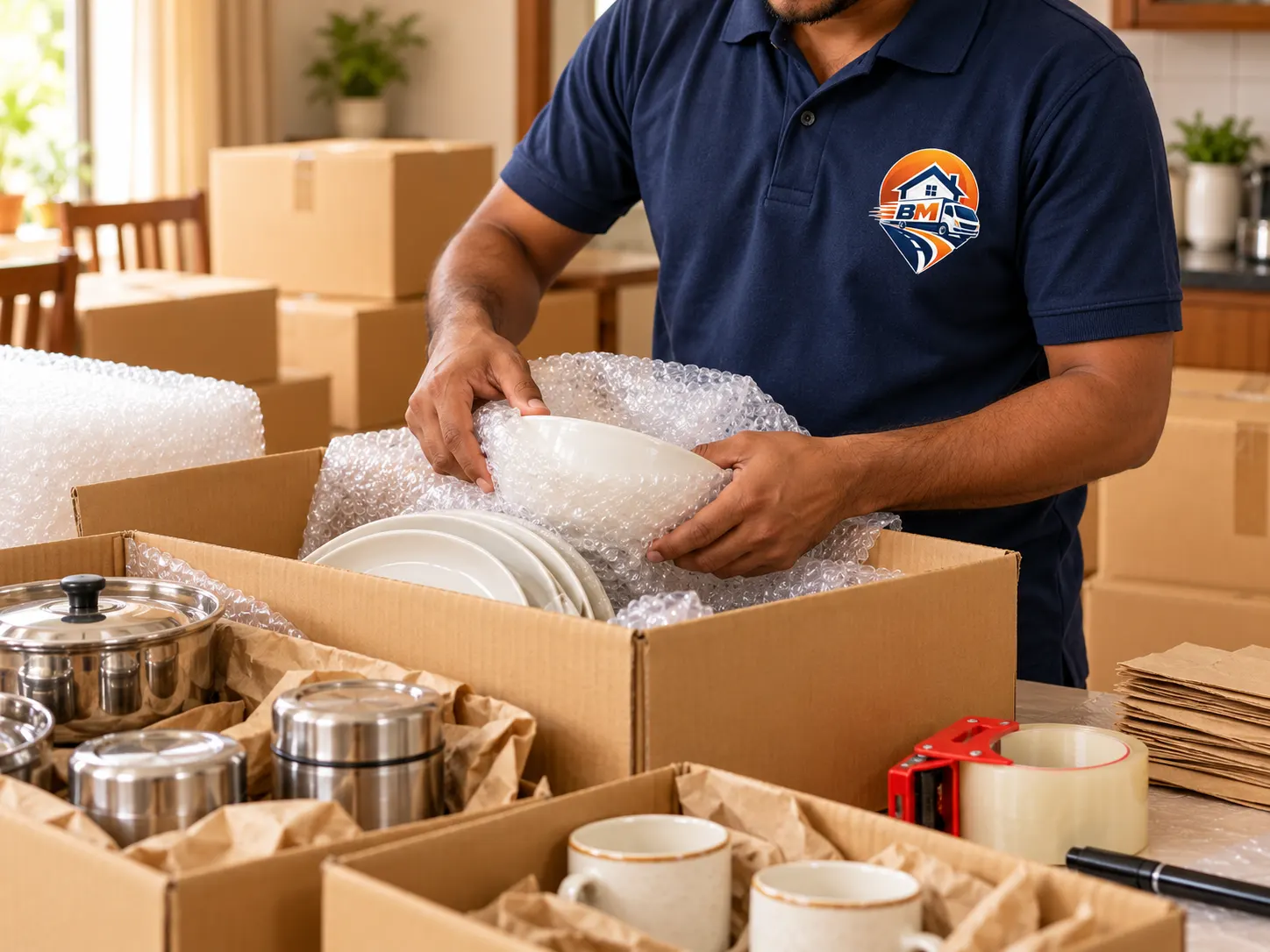
Each plate should be wrapped on its own and packed standing on its edge, like records, rather than stacked flat. Plates on edge share the load and are far less likely to crack. Line the bottom of the carton with padding, fill gaps so nothing moves, and put lighter items on top.
Glasses and stemware
Wrap each glass separately and stand it upright, with padding between glasses. Stemware needs extra care at the stem; some packers use dividers in the carton. Mark these cartons "Fragile — this side up" on more than one side.
Utensils, pans and pressure cookers
Nest pans and pots with paper between them. Pack pressure cookers with their lids and gaskets together so nothing goes missing. Knives should be wrapped and their blades covered, and the carton labelled so whoever unpacks it knows.
Jars, spices and dry goods
Tape lids shut or seal jars in zip bags. Finish open spice packets before the move or put them in a sealed container. Heavy jars and tins go at the bottom of a small carton — small, because a large carton full of jars becomes too heavy to lift safely.
Liquids
Oils, sauces and cleaning liquids are the most common cause of mess in a moving truck. Carry what you can with you. Anything that has to go in the truck should be sealed, packed upright in a plastic bag and kept away from fabric and electronics. Ask your mover what they won't carry.
| Item | How it should be packed | Carton |
|---|---|---|
| Plates | Wrapped individually, standing on edge | Small or medium, marked fragile |
| Glasses | Wrapped individually, upright, padded between | Small, with dividers if possible |
| Pots and pans | Nested with paper between | Medium |
| Pressure cookers | With lid and gasket together | Medium |
| Knives | Wrapped, blades covered | Labelled clearly |
| Jars and tins | Lids taped, heavy items at the bottom | Small |
| Liquids | Sealed, upright, in plastic bags | Separate box, or carry them |
| Small appliances | In original boxes or well padded | Medium, labelled |
Appliances
Defrost and dry the fridge a day before and tape its doors. Remove the microwave plate and pack it separately. Mixers and small appliances travel best in their original boxes, or well padded. For gas stoves and cylinders, follow your gas company's guidance and check what the mover allows.
Kitchen packing checklist
Packing materials that work
- Small and medium double-wall cartons — large boxes get too heavy with kitchen items
- Packing paper for wrapping, bubble wrap for the most fragile pieces
- Carton dividers for glasses and stemware
- Zip bags for spices, small parts and lids
- Strong tape and a marker for labels on more than one side
If you pack the kitchen yourself
Start a few days early with what you rarely use: serving dishes, special-occasion crockery, spare appliances. Leave everyday items for the last day. Fill every gap in a carton with crumpled paper so nothing can shift, and test each carton by gently lifting it: if anything rattles, add more padding. Label each carton with the room and its contents.
Common kitchen packing mistakes
- Stacking plates flat instead of standing them on edge
- Using large cartons for heavy items like jars and tins
- Leaving gaps in cartons so items move in transit
- Packing liquids with fabric, books or electronics
- Forgetting to mark fragile cartons on more than one side
Unpacking in the right order
Unpack the kitchen early, starting with the first-night box and everyday items. Check fragile cartons first so that any damage is noted on the delivery note while the crew is still there. Put back what you use daily before the rest; serving dishes and spares can wait until the house is in order.
The fridge, the day before
Switch off and empty the fridge the day before the move, leave the doors open to defrost, and wipe out every drop of water. A damp fridge in a closed truck can grow mould or leak onto other goods. Tape the doors shut and secure loose shelves inside, or pack them separately. At the new home, many people wait a few hours after moving before switching the fridge back on; check the manufacturer's guidance for yours.
Labelling the kitchen
- Mark every kitchen carton "Kitchen" and number it
- Write the main contents on the side, not just the top
- Mark fragile cartons on at least two sides
- Use a different colour or mark for the cartons you'll open first
Packing for a long-distance move
On a long road move, cartons are stacked higher and travel further, so packing needs to be firmer. Use more padding, choose sturdier cartons and fill every gap. Avoid packing anything that can spoil, and ask the mover whether their packing changes for a long route.
Quick answers
- Should I pack the kitchen myself or leave it to the movers? Either works; professionals are faster, but check their method against this guide.
- How early should I start? Pack rarely used items a few days ahead and everyday items on the last day.
- Can I move open food? Avoid it on long moves; finish it or give it away, and carry anything you need for the first day.
- What about the gas cylinder? Follow your gas company's guidance and check what the mover allows before packing it.
- Which carton should I open first? The first-night box, then the cartons marked for daily use.
Small appliances and their parts
Mixers, toasters, kettles and coffee machines each have small parts that go missing easily: blades, jars, lids, filters and cables. Pack each appliance with all of its parts in one box, put the small pieces in a zip bag taped inside, and write the appliance's name on the outside.
The first-night box
Keep one box with you: a pan, a few plates, cups and cutlery, tea or coffee, a knife, a cutting board, dish soap, a towel and any medicines. You'll be glad of it when the boxes are still sealed on the first evening.
If you'd rather leave the packing to professionals, home shifting through bookmovers.in includes packing by a verified mover. Ask them how they pack the kitchen, using this guide as a check.